
Steam UI Redesign: Tauri Desktop Architecture
TL;DR
Role: Frontend / Desktop App Developer
Timeline: 1 month
Tech Stack: Next.js, Tauri, Rust, Tailwind CSS
The Goal: Engineer a lightweight, native-feeling desktop prototype of the Steam client by moving away from heavy Electron architecture and utilizing Tauri for a smaller, faster footprint
1. The Concept: Modernizing Desktop Apps
Many modern desktop applications (like Discord or the current Steam client) rely on frameworks like Electron or CEF, which bundle an entire Chromium browser environment into the app. This often leads to bloated file sizes and high RAM usage.
For this project, the goal was to take a complex, high-fidelity Figma design of a redesigned Steam client and engineer it using Tauri. Tauri solves the bloat problem by using the OS's native webview (WebView2 on Windows, WebKit on macOS) paired with a Rust backend, resulting in a drastically smaller and faster application.
2. The Solution & Core Feature
To bring the design to life, I built a modular frontend driven by Next.js and bridged it to a desktop window using Tauri.
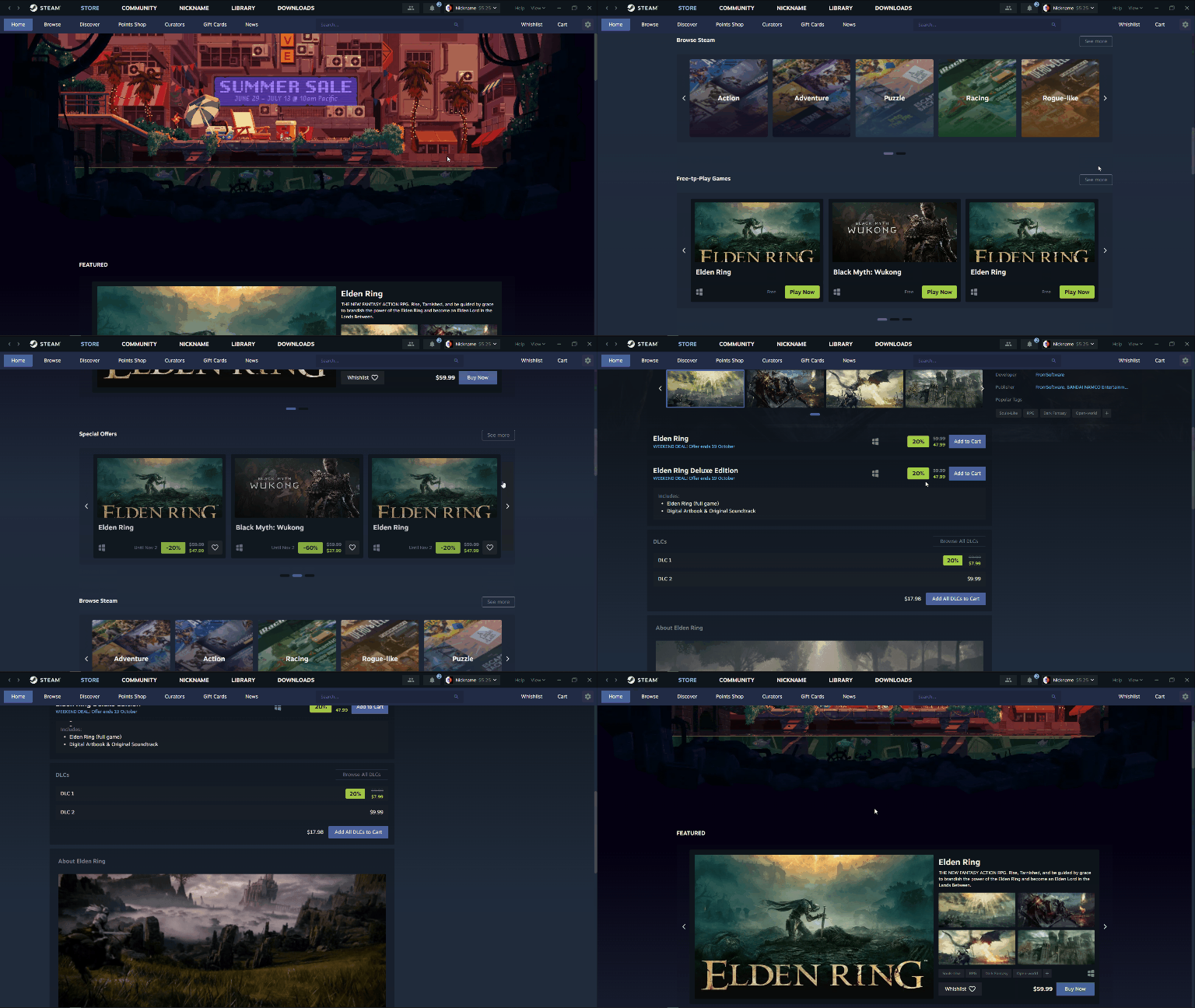
- A. Next.js Component Architecture: I broke down the complex Figma layout into reusable React components, building out dynamic grids for the storefront (featured, trending, special offers) and rich media layouts for individual Game Detail views.
- B. High-Fidelity UI Implementation: I translated the design into a responsive, desktop-first UI using Tailwind CSS. To make it feel like a native app rather than a website, I implemented strict overflow controls, disabled standard web text-highlighting, and locked layout dimensions.
3. The Engineering Challenges
Translating a web framework (Next.js) into a localized desktop executable presented several unique architectural challenges:
- A. The "Native Shell" Architecture Instead of exporting a static bundle, I architected Tauri to act as a lightweight, native OS shell. The frontend runs as a standard Next.js web application, while Tauri renders it seamlessly inside a native webview. The primary challenge was configuring this dual-environment setup so that the Next.js dev server and the Tauri client run in tandem during development.
- B. Pixel-Perfect Execution: Translating the exact spacing, typography, and color gradients from Figma into a fixed-dimension (1200px+) desktop window required strict adherence to component modularity and Tailwind configuration.
4. The Results & Impact
This prototype successfully proves that complex, media-heavy desktop interfaces can be built without the overhead of Electron.

- Optimized Footprint: By leveraging Tauri and Rust, the resulting application bundle size is a fraction of what a comparable Electron app would be.
- 1:1 Design Accuracy: Achieved a pixel-perfect functional clone of the provided Figma file, demonstrating strong frontend UI/UX translation skills.
- Cross-Platform Ready: The Next.js and Tauri codebase is architecturally capable of compiling into native executables for Windows, macOS, and Linux from a single source.
5. Future Iterations
Current Status: The application is currently a high-fidelity frontend prototype. The current scope focuses purely on the most complex UI layouts: the main Storefront dashboard and the Game Detail pages.
Next Steps:
- Native IPC Communication: I plan to engineer a communication bridge between the Next.js web context and the Tauri Rust backend. This will allow custom UI buttons (like minimize, maximize, and close) to trigger native OS window events.
- State Management: Implementing global state to handle cart additions and user library filtering across the storefront.