
RSNA Hemorrhage Detection
Overview
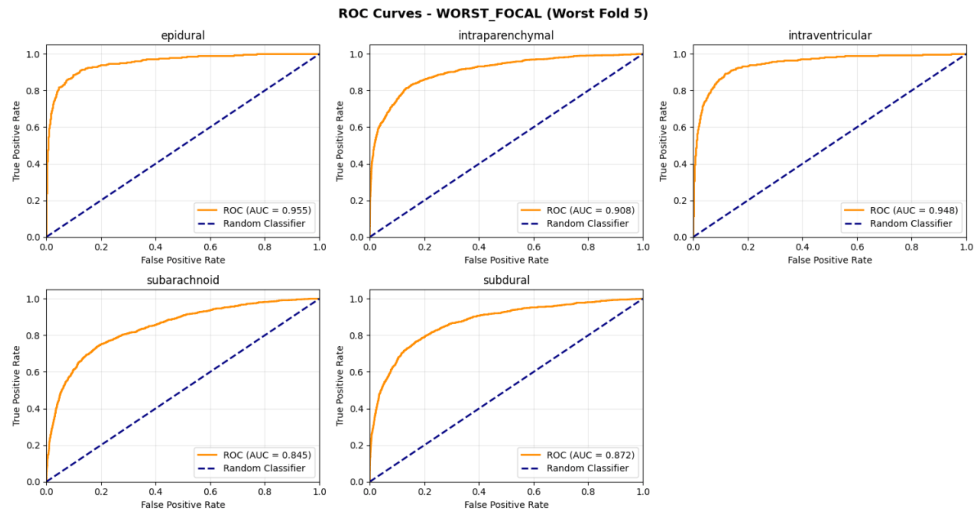
Developed a multi-label classification pipeline to detect five types of intracranial hemorrhages (epidural, intraparenchymal, intraventricular, subarachnoid, and subdural) using the RSNA dataset. The project focused heavily on handling severe class imbalances and understanding the trade-offs between precision and recall in a clinical setting.
Architecture & Methodology
- Selective Fine-Tuning: Leveraged a pre-trained ResNet-18, adjusting the first convolutional layer for grayscale images. To reduce overfitting and computational cost, the backbone was frozen, leaving only the final convolutional block and fully-connected layers trainable.
- Validation: Implemented robust 5-fold cross-validation to ensure stable performance metrics.
The Ablation Study
To find the optimal configuration for this specific medical task, I conducted a systematic ablation study focusing on three core areas:
- Data Balancing: Compared standard oversampling, oversampling with aggressive augmentation, and Weighted Loss (BCE).
- Loss Functions: Evaluated CrossEntropyLoss, BCEWithLogitsLoss, and Focal Loss.
- Optimizers: Compared Adam, RMSprop, and SGD alongside various Learning Rate Schedulers.
Results & Clinical Insights
- Loss Function Failures & Successes: The study proved that standard CrossEntropyLoss completely fails for this multi-label task (3.41% exact match accuracy), whereas Focal Loss achieved the best overall F1 score and precision by effectively managing class imbalance.
- The Augmentation Trap: Surprisingly, combining oversampling with heavy data augmentation degraded the F1 score by 1.6%, likely due to the model learning artificial distortions of minority classes. Simple oversampling was far more effective (+2.6% F1).
- Clinical Optimization (Recall vs. Precision): While Focal Loss and RMSprop maximized precision, using a Weighted Loss function with the Adam optimizer increased recall by 5.11%. I concluded that for real-world medical screening—where missing a diagnosis (false negative) is highly penalized—this high-recall configuration is the superior choice.